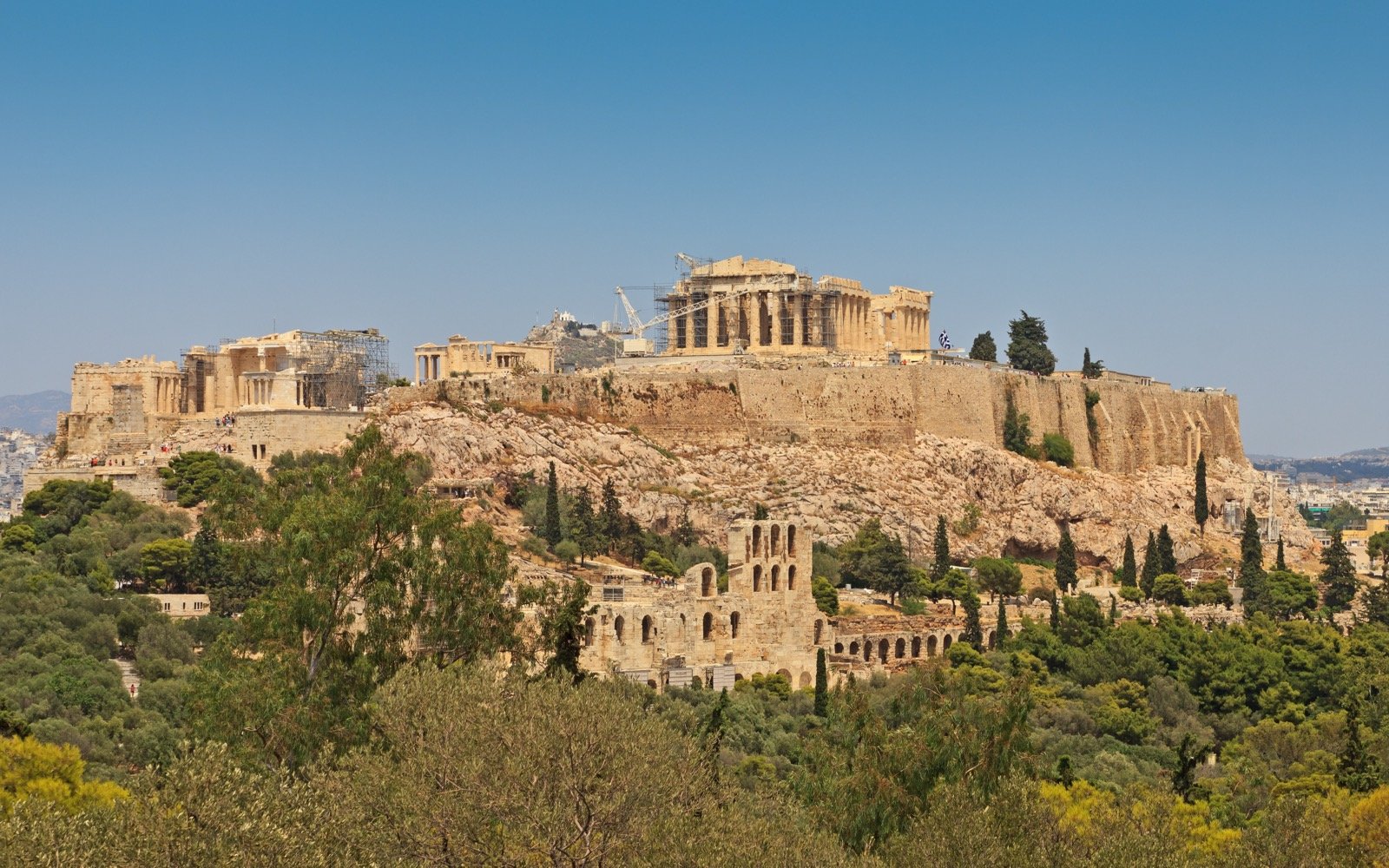
Athens is the capital and largest city of Greece, and one of the oldest continuously inhabited cities in the world, with a history of settlement spanning more than 3,400 years. According to Greek mythology, the city was named after the goddess «Athena», who won it in a contest against the god «Poseidon» by gifting its people an olive tree.
The Cradle of Democracy and Philosophy
In the 5th century BC, Athens experienced a golden age that gave rise to history's first experiments in democratic government, and philosophy flourished under Socrates, Plato, and Aristotle. Atop the «Acropolis» hill overlooking the city, the «Parthenon» temple stands as a testament to the genius of classical Greek architecture since its completion in 438 BC.
- The Acropolis and the Parthenon are a UNESCO World Heritage Site
- Athens hosted the first modern Olympic Games in 1896
- Plato's Academy is considered one of the oldest institutions of higher learning in history
- The ancient Odeon of Herodes Atticus theatre still hosts live performances today
Athens today blends its classical ruins with the life of a modern European capital, from its bustling markets to artistic neighborhoods like the old «Plaka» quarter at the foot of the Acropolis.