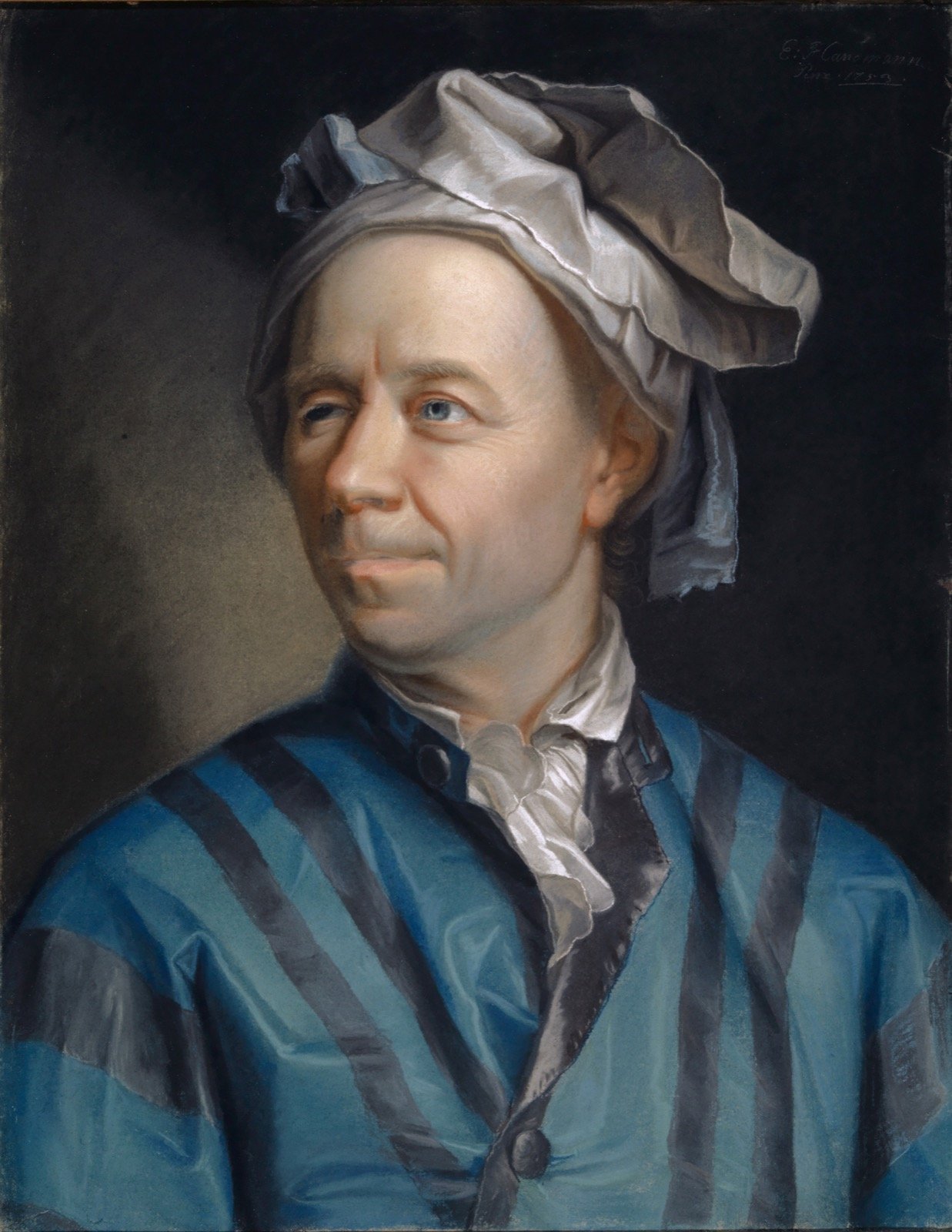
Leonhard Euler was born in 1707 in Basel, Switzerland, and studied under Johann Bernoulli, one of the foremost mathematicians of his era. He spent most of his career at the Saint Petersburg and Berlin Academies of Sciences, producing an immense body of work estimated at over eighty volumes, making him arguably the most prolific mathematician in history.
Euler established much of the mathematical notation used today, including f(x) for functions, e for the exponential constant, and the now-standard use of π for the ratio of a circle's circumference to its diameter. He also formulated «Euler's formula», linking exponential and trigonometric functions through imaginary numbers, often described as the most beautiful equation in mathematics.
Scientific Legacy
Euler gradually lost his eyesight, becoming completely blind late in life, yet continued producing prolific mathematical research by dictating to assistants until his death in 1783. He contributed to number theory, calculus, mechanics, astronomy, and founded graph theory by solving the famous Seven Bridges of Königsberg problem in 1736.