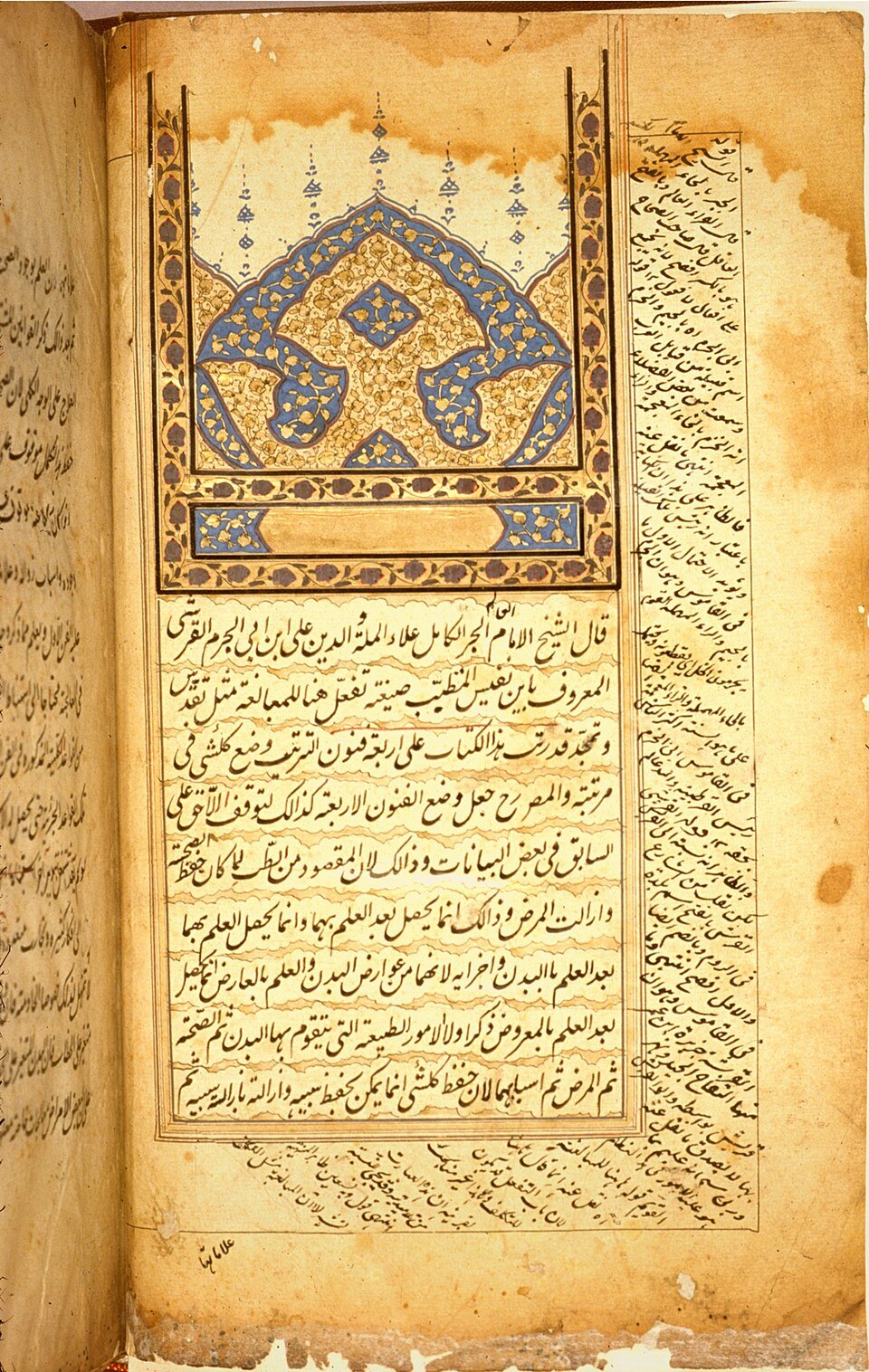
Ala al-Din Ali ibn Abi al-Hazm al-Qurashi, known as Ibn al-Nafis, was born in Damascus and studied medicine at its renowned Nuri Hospital under leading physicians, before moving to Cairo, where he became chief physician at the Mansuri Hospital and personal physician to several Mamluk sultans, alongside a continued interest in jurisprudence and its principles.
Discovering Pulmonary Circulation
Ibn al-Nafis is credited as the first to accurately describe the pulmonary (lesser) circulation of blood, showing that blood travels from the heart's right ventricle to the lungs and then to the left ventricle — contradicting the ancient Greek theory of Galen, which had prevailed for over a thousand years and claimed that blood passed through invisible pores in the wall separating the heart's two ventricles. This discovery came centuries before the European anatomist William Harvey described the greater circulation of blood, and Ibn al-Nafis's scientific credit in this field was only recognized in the twentieth century, after his manuscripts were rediscovered. Ibn al-Nafis also authored a massive medical encyclopedia titled Al-Shamil fi al-Sina'a al-Tibbiyya, which he intended to span three hundred volumes, in addition to a detailed commentary on Ibn Sina's Canon of Medicine.
- First accurate scientific description of the pulmonary (lesser) circulation of blood
- Authored the medical encyclopedia Al-Shamil fi al-Sina'a al-Tibbiyya
- Wrote a detailed anatomical commentary on Ibn Sina's Canon of Medicine
- Combined medical practice, hospital leadership, and jurisprudential scholarship
Upon his death, Ibn al-Nafis bequeathed his house and library to the Mansuri Hospital, leaving behind a medical and scientific legacy centuries ahead of his time.